
A new shop with no sales history is a stranger at the market, and both Etsy and shoppers treat strangers carefully. Etsy's algorithm favours listings with proof they can convert, and shoppers favour listings with reviews. And you don't have either yet. This is the in-between period, and most sellers respond to it in one of two unhelpful ways: Waiting politely for the algorithm to notice them, or panic-changing everything every two days.
You're going to do neither. This stage is about giving your flywheel its first deliberate push, and then we analyse the data to inform your next move. The aim in this Stage is to build Etsy into something sustainable for you: sales create reviews, reviews create trust and ranking, trust and ranking create more sales. It's slow to start and powerful once spinning. Your job in this stage is the first few turns of your flywheel: earn the early sales, turn them into reviews, and then, once the numbers say your listings are ready, ramp up with paid traffic and a fulfilment routine that scales with you.
Came here via The Trend Fast Lane? Move through this stage at double speed. Waves don't wait, so compress the timelines, start your ad test in week one, and let the trend's momentum do the pushing.

Before you spend a single dollar or change a single listing, learn to read what your shop is already telling you. Learning to read Etsy Stats is important, and is simpler than you think, because everything funnels through three numbers: how many people see your listings, how many visit them, and how many buy.
Each weak point in that funnel has a different cure, and mixing them up wastes time. Here's the diagnosis:
Low views? You have a visibility problem, not a selling problem. Shoppers aren't finding you. The fix lives back in Stage 2, Step 4 and 6: better product photos and more targeted long-tail keywords. But first, give it time. New listings can take a days to weeks to settle into search, so don't rip up keywords that haven't had a chance to work. In the very beginning, it could be better to use your time for creating more product listings rather than changing things mindlessly.
Views but no orders? (Conversion well below your niche's healthy range; more on that in a moment.) You have a persuasion problem. Shoppers are finding you and deciding no. The suspects, in order of likelihood: the hero photo isn't earning trust up close, the product isn't meeting expectation, the price feels wrong for what the photos show, or a doubt isn't being answered. Re-run Stage 2 on your weakest listings before touching anything else.
Decent conversion but a trickle of traffic? Congratulations, you have the good problem. Your listings can sell; they just need more people through the door. You're ready for testing running ads in Step 4.
A word on what "decent conversion" means, because it isn't one number. Etsy's overall average sits around 1 to 3%, but different niches have different averages. In broad, fiercely competitive categories like jewelry or many digital products, shoppers open a dozen tabs and compare for days, so a healthy, well-built listing can be lower at 0.5-1.5%. In really specialised niches, a fandom shop, a specific hobby, a trending product, the shoppers who arrive are practically pre-sold, and 3 to 5% is genuinely reachable. So set your benchmark against your own corner of the market, and pay more attention to the trend than the absolute number: a listing that climbs from 1% to 2% is telling you your changes work, whatever the niche average says.
Two habits to build now. First, check weekly, not hourly. Daily numbers on a young shop are noise, and staring at them is how Etsy sellers burn out in month two. Pick a day, spend ten minutes, write down views, visits, orders, and conversion rate per listing in a simple tracker. Second, diagnose before you act, every time. Don't act without knowing why.
Go deeper: The Conversion Masterclass (the six gates, which turn a diagnosis into a repair list)
Toolbox: Weekly Stats Tracker
The first few sales are the hardest sales you'll ever make, because you're making them without any momentum. So we don't wait for them. We go and get them, honestly, using every lever you've already built.
1. Tell your warm crowd
This is the moment your Stage 2 'Show Your Work' habit pays its first dividend. Email your little link-in-bio list with the launch and their promised first-look offer. Post the launch to your socials, where a handful of people may have been watching your shop get built and are quietly rooting for it. Tell friends and family, with one firm rule attached: genuine purchases only, and don't stage reviews. Fake reviews break Etsy's rules and can get you in trouble. Instead, you can explain your product in a genuine and passionate way to people you know, which they will appreciate.
2. Run a modest launch offer
Remember the margin you deliberately protected in Stage 2, Step 3? This is what it was for. A launch discount of 10 to 15% gives shoppers sitting on the fence a reason to be first, without training anyone to expect permanent sales. Give your 'Opening Sale' an end date and stick to it (usually a week works great).
3. Switch on Etsy's automatic offers
In your marketing settings, set up targeted offers so Etsy automatically sends a coupon to shoppers who favourite an item, abandon a cart, or recently received an order. Usually 5-10% is great here. These are the some of the warmest possible leads on Etsy (they already show interest in what you're selling) and the whole system runs itself once configured.
4. Use honest scarcity
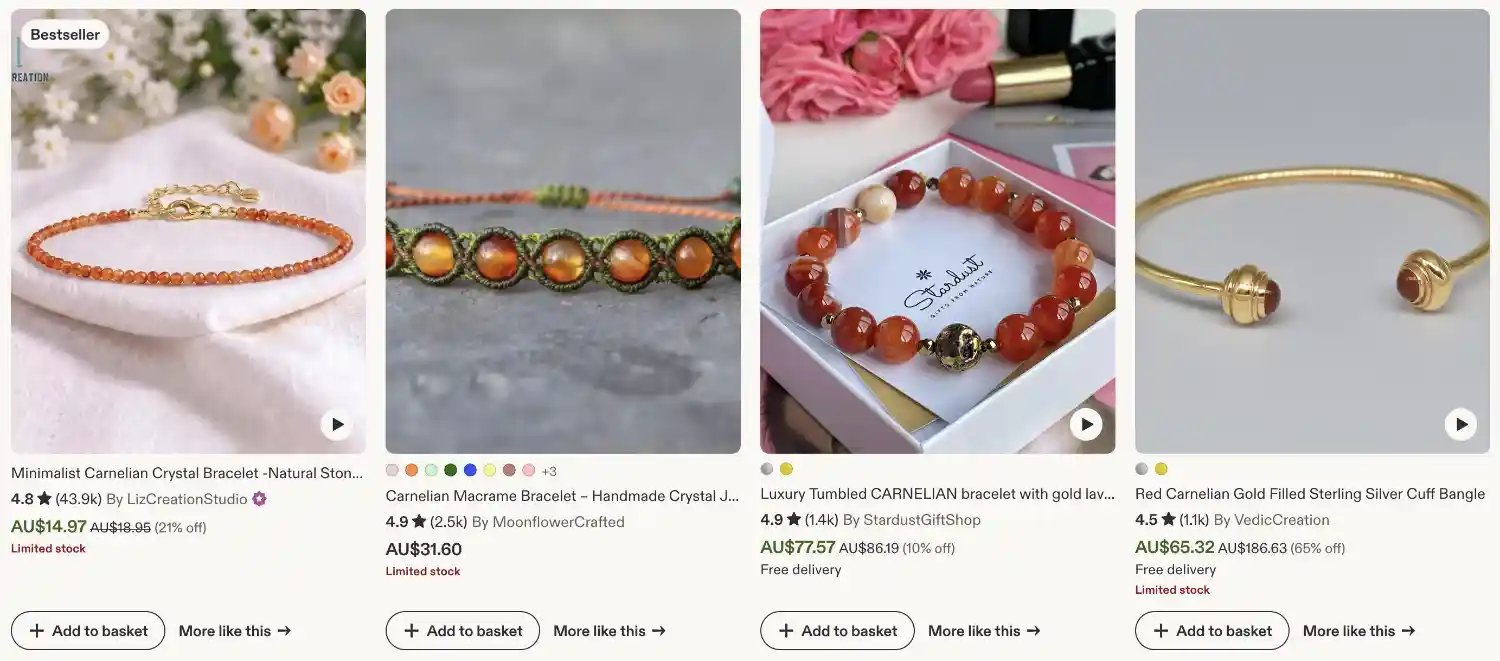
Set the listed quantity of your best pieces to 3 or fewer, and Etsy could show urgency signals like red text "Limited stock" on the search result page, and "only 3 available and in other baskets" inside the listing. You're not inventing fake scarcity;Handmade work genuinely is small-batch and scarce. You're just letting Etsy know.
5. Bundle for a second doorway
Combine related products into a new bundle listing: the candle with the matches and the tray, the earrings with the matching pendant. Make sure the products featured in the bundle make sense. While you can use Etsy's bundling option (under Sales and Discounts), making a bundle listing manually creates a new listing with new keywords ("gift set for her"), which allows you to reach more shoppers. Making bundles can also increase your order value, and have a ready-made answer for gift shoppers who want the choosing done for them. Think back at Stage 1 when you studied what your customer was buying the product for to decide the products.
Go deeper: The Customer Psychology Modules (honest scarcity and urgency, and more strategies using psychology)
Reviews are the compounding asset of an Etsy shop. Every single one makes the next sale slightly easier: They feed your search ranking, they answer the shopper's deepest question ("has this gone well for someone like me?"), and they stay in your shop. Going from zero reviews to twenty changes how your whole shop converts. So we build the engine now, right after the first rush of orders and deliberately before we spend money on ads, because every review you gather makes the paid traffic in the next step convert better and cost less.
1. Earn them
There's no shortcut to reviews. You kind of have to earn them: Accurate photos that promise only what arrives, an unboxing that gives a great first impression, on-time delivery, and of course, a great product that satisfy or exceed customer's expectations. Reviews are the result of all of that plus customer service. That's your foundation of getting positive reviews, but there are extra things you can do to improve the chances.
2. Let the insert card plant the seed
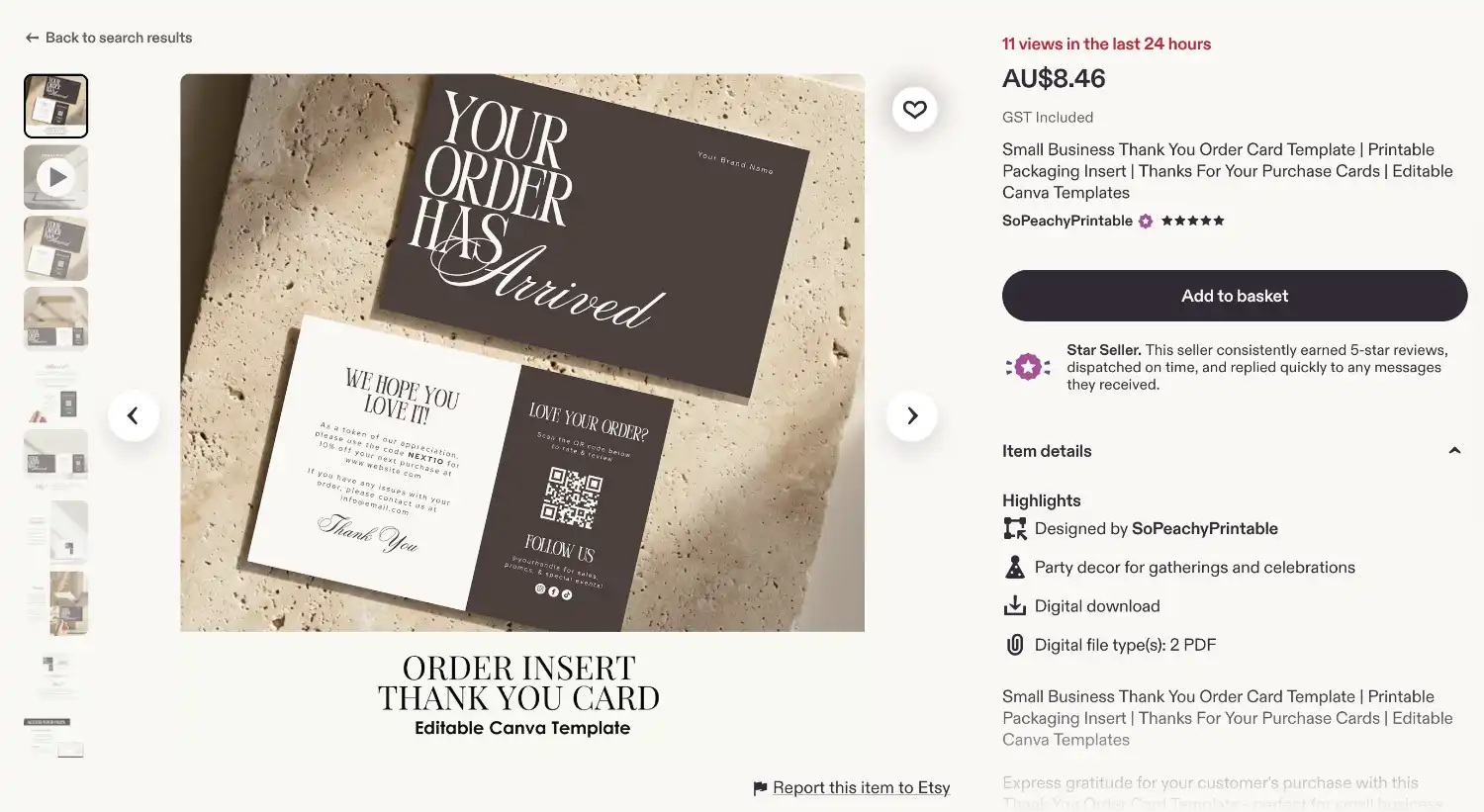
The insert card is put in every order as we talked about in Stage 2 packaging design step, which should include a friendly ask and a QR code. It catches your customer at the exact moment of peak delight. You can buy an order insert card templates like this one on Etsy, or create your own using Canva:
3. Ask, once, nicely
A lot of happy customers simply forget to review, not because they didn't love it, but because everyone is busy. A single friendly follow-up a few days after tracking shows delivery can solve this problem. "I'm so glad your order arrived; Hope you love it; If you have a moment, a review would mean a great deal to a small handmade shop." Save this review ask message as a template and it becomes a thirty-second habit per order (Step 5 folds it into a tidy message routine).
4. Recover the bad ones calmly
A negative review will arrive eventually. It's inevitable. And your first move is the most important one: Do not reply publicly. A public response locks the review permanently and it can't be changed even if you fix the customer's issue. Instead: breathe, message the customer privately, lead with empathy, and offer a clear fix, a replacement or a refund. Follow through completely. Then, once the problem is genuinely solved, gently ask whether they'd consider updating their review. Most will. For some message templates, see "What To Say When Things Go Wrong" in the deep dives section.
Go deeper: What To Say When Things Go Wrong (the six-step playbook for a bad review, plus word-for-word replies for damage, delays and refunds)
Etsy Ads can either be a profitable tap you turn on, or a hole you pour money into, and the difference is almost never the ads. It's the listings underneath them. Ads buy views; they don't buy conversions. Which is why this step waits until now. You should only send paid traffic to listings that have proven they can convert from 'views' to 'sales'. Paying to run ads on listings that don't convert is like filling a leaky bucket, and it is the single most common way new sellers lose money on Etsy.
If your listings are converting, ads become a straightforward experiment. Run it like this:
1. Only run ads on your proven listings
Select listings that have already made sales, preferably those with reviews. Brand-new unproven listings can wait for a later round. Set a small daily budget of around $5, and then, and this is the hard part, keep your hands off changing things and let it run.
2. Know your break-even before you look
Here's where your Stage 2 cost sheet comes in again. You know your margin per sale, so you know exactly how much ad spend one sale can carry before it stops being profit. Write that number down before reading any results. It's the difference between judging with maths and judging with mood.
3. Know when to stop and read
Ads need data before they deserve judgement, so give the test a finish line and don't change anything before it. The rule: Analyse when you reach two full weeks or roughly 100 ad clicks across the test, whichever comes first. You can judge an individual listing only once it has around 30 clicks of its own. Below that, the data is not 'certain' and could be affected by many factors. (A listing with 30+ clicks and no sale, on the other hand, is telling you something loud and clear.) Put the analysis date in your calendar on the day you launch the test, and let the ads run untouched until then.
4. Sort the results into three piles
When the finish line arrives, sort your advertised listings. Winners: Sales at or under your break-even spend. Fixable: Plenty of clicks, no sales. The Etsy ad is doing its job and the listing isn't. They have potentials to become winners. Duds: Barely any clicks despite impressions. Switch the ads off for them.
5. Reverse-engineer your winners
Celebrate your winners, but they also serve a deeper purpose: Giving you valuable information and direction. Before touching the fixable pile, put the winner and a duds side by side and look at the difference in this order:
- The search terms. Open the ads dashboard and look at which shopper searches actually brought the winner its clicks and sales. These are the keywords that brings you clicks and then sales. Now compare them to the losing listing: are they targeting keyword phrases like these?
- The thumbnails. Shrink both hero shots to search-result size and be honest: which one would you click? Are the winners' photos brighter with a clearer focus? Does it have a text overlay? Whatever the winner's cover photo is doing, try applying it to the losing listings.
- The price. Compare each against its first-page neighbours. Winners often sit at a believable sweet spot; losers are often a few dollars into "something must be off" territory, in either direction.
- The completeness. Is there a listing video? Gift information? Scale photo? Information to eliminate barriers? Losers are often simply missing one or two crucial elements the winner has.
Then fix the fixable pile one change at a time, starting with whichever difference was most glaring, and re-enter those listings in your next test round. One change at a time matters for this pile of listings: If you change five things and a listing improves, you don't learn much on how to improve for the next one.
6. Scale what earns, or disable Etsy ads for now
Leave the winners alone and simply raise their budget, gradually, re-checking the maths at each step (and especially in Q4, when ad prices/cost per ad click increase). Winners rarely need improving; they need more budget. If the test found no winners at all, that's not failure, that's an answer: A data-backed decision to not run ads at this time, until your shop has changed drastically in the future to try again.
Go deeper: The Full Ads System (reading the dashboard, scaling winners, and what to do with the losers)
Toolbox: Weekly Stats Tracker
Orders are arriving, and if your ad test found winners, they're arriving faster. Reputation, in the form of reviews and repeat buyers, is the fuel the flywheel runs on. The good news is that shipping and delivering is mostly a matter of routine, and doesn't require constant focus and problem solving. So in this step, we are going to build the routine to help you establish a reputation.
Extra note for digital sellers: your delivery is instant and automatic, which doesn't remove this step; it changes the focus. "Ship on time" becomes "the download works, every time": test your files on a phone and a computer, keep the folder structure self-explanatory, and let your "start here" PDF from Stage 2 answer the how-do-I-print-this questions before they're asked. Your saved replies needs to answer file help questions ("can't open it", "which size do I choose"), and since there's no tracking number, your review follow-up simply goes out a few days after purchase instead of after delivery. Everything else in the step, the 24-hour replies, the calm playbook, the twice-daily batches, applies to you unchanged.
1. Ship on time, every time
Your processing times from Stage 2 should be honest and slightly padded. Batch your making, batch your packing (all four packaging layers and the insert card, every parcel), and batch your shipping (pick 2 days as your ' package + post office' days). And always, always use tracking, with insurance for high-value pieces. Tracking isn't just protection; it's the answer to half the messages you'll ever receive.
2. Reply within 24 hours, with templates doing the lifting
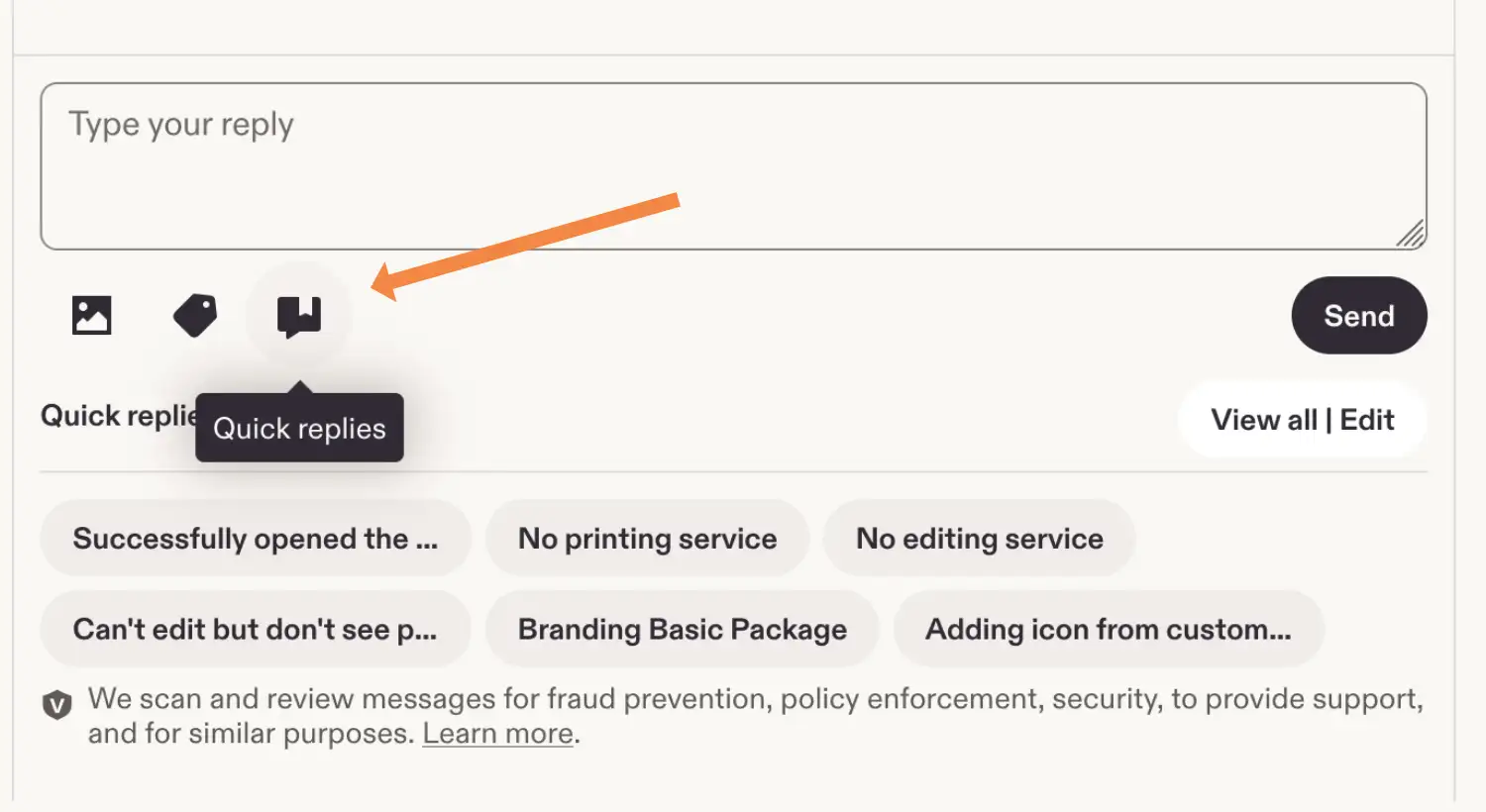
Fast, warm replies win sales from slower competitors (and also count towards you getting your Etsy's Star Seller badge). But fast doesn't mean glued to your phone. Set up Etsy's saved replies using the Customer Message Swipe File in your Toolbox: the shipping question, the sizing question, the custom request, the "is this in stock" question. Answer messages in two batches a day, morning and evening, put the Step 3 review requests into the same batches, and let the templates keep your reply professional and on brand even on your off days.
3. Handle problems with the calm playbook
A package will go missing. Something will arrive damaged. That is just inevitable shipping physical objects across countries. When it happens: reply quickly, lead with empathy, and offer the clear fix (give them the option of replacement or refund). You cover the cost when the fault is the journey's or yours; the buyer covers return postage for a simple change of mind (see whether that's what your Stage 2 policies already say). Here's the counterintuitive part: a problem handled swiftly and generously often creates more loyalty than an order with no problem at all. People remember how you showed up.
4. Keep books like a business
Steady orders mean you now run a proper business, and businesses keep records. Nothing fancy is required: once a month, log your income and every expense (materials, packaging, postage, subscriptions, fees) in the Income & Expense Tracker, download your Etsy fee statement, and file it. It takes you thirty minutes, but it lets you know whether the shop actually makes money, and when tax time arrives in your country, you'd be glad that you have kept a clean record.
Toolbox: Income & Expense Tracker · Operations Kit
Alongside the milestones, start posting simple in-progress and behind-the-scene content: the half-glazed mug, the pinned fabric, the prototype sketch, the messy workbench half way through making an order. Being candid and a bit rough around the edges is the point, and it's exactly the human-made proof that will benefit you. But still keep these in mind: keep what you want to say clear, keep your hands steady when filming (or lean the phone against something), and shoot in natural light.
And remember the insert cards from your Stage 2 design are quietly helping you spread your social media reach. Every parcel is now inviting its customer to scan, follow, and join your list, which means every sale Etsy sends you is also, softly, becoming an audience member you keep.
Now notice the quiet vulnerability underneath it. Nearly every one of those sales arrived through one doorway, Etsy's search, and that doorway belongs to someone else. The customers, though, the actual humans who loved your work enough to buy it? Right now most of them are strangers you can't contact tomorrow. Stage 4, Own Your Customers, fixes exactly that: turning the buyers Etsy sends you into an email list and a repeat-customer base that no algorithm change, fee increase, or policy update can take away from you. The insert cards already riding along in your parcels are the first plank of that bridge. It's time to build the rest of it.