
You're going to do this differently. In this stage, you'll choose a niche where demand already exists, get to know the customer you're serving well enough to predict their questions, and shape a product that gives them a clear reason to pick you over the shops already there. It's the least glamorous stage of the roadmap but possibly the most important, because everything you build afterwards stands on it. Research is to a shop what a foundation is to a house: invisible when it's done right, and the reason everything cracks when it isn't.

Before you start, print out the "Niche Research Workbook" to work through this stage.
A niche is simply a specific corner of the market: not "candles" but "dessert-scented candles for cosy gift-givers." We start wide before we narrow, so your first job is to generate candidates without analysing them yet.
Open a blank page and work through these prompts:
Start with your hands. What can you already make well? What do people compliment or ask you to make for them? Skill you already have is a head start no research can replace.
Look at your unfair advantages. Materials you can source cheaply locally, materials that's unique to your area, a style you've developed over years, knowledge of a community you belong to (new parents, hikers, teachers, D&D players, fandom). The best niches often sit where your craft crosses a world you genuinely understand, because you'll know that customer better than any outsider can.
Browse Etsy itself. Wander your craft's category for twenty minutes and note what's selling and what sparks ideas.
Watch for the traps. As ideas land on the page, flag the ones with built-in problems: Products that only sell for six weeks a year (seasonal), items on Etsy's restricted list (copyrighted items, drugs & alcohol, dangerous items, etc), and things that are heavy, fragile, or awkward to ship. None of these are automatic nos, but they have a barrier to entry you should know now, not discover later.
Aim for 10 to 20 candidate ideas. Messy is fine. We will do the judging and analysis in the next two steps.
Extra note for digital sellers: everything in this stage applies to digital products too: printables, planners, patterns, SVG bundles, templates. Brainstorm, validate, and niche down exactly the same way; a wedding-invitation template has a persona and a gap just like a ceramic mug does. One honest caution, though: digital categories are the most crowded corners of Etsy and the ones most flooded by low-effort AI listings, which means your USP and the originality of your design carry double the weight here. The good news is that the flood works in your favour once you stand out from it, because shoppers wading through sameness reward the seller with a genuine point of view. The Etsy Digital Product Playbook is your companion deep dive for the whole road.
Toolbox: Niche Research Workbook
Etsy will tell you what's selling if you know where to look. No paid tools required for this step if you don't want to pay extra. Open an incognito browser window first, so your own history doesn't affect what Etsy shows you, and take your top candidates through these checks one at a time.
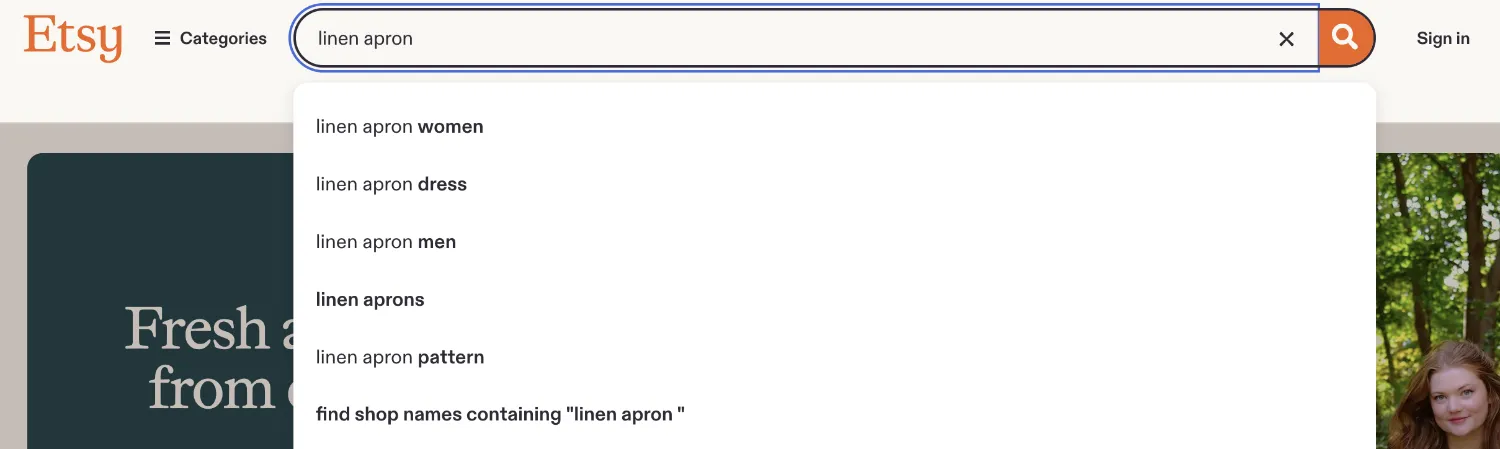
Read the Etsy search bar. Start typing your niche into Etsy's search bar and pause. The autocomplete suggestions are real phrases real shoppers type, ranked roughly by popularity. If "linen apron" autocompletes to "linen apron with pockets", that's the market telling you what it wants and that real Etsy shoppers are searching for that.
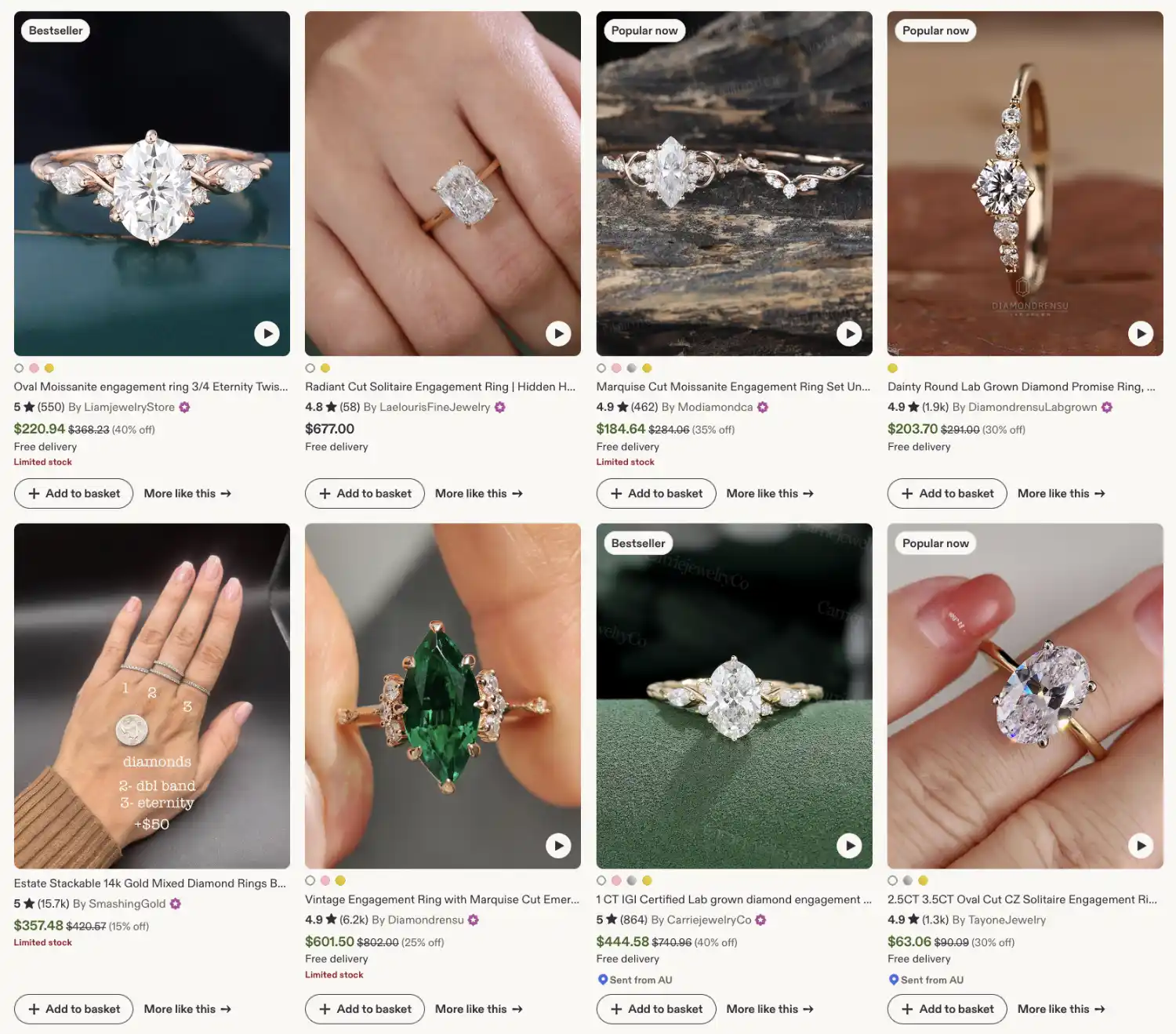
Look for the demand badges. Search your niche and scan the first two pages for Etsy's own signals: "Bestseller" badges, "Popular now" labels, and "In 20+ baskets" tags. These only appear on listings with genuine buying activity. A niche where the front page is dotted with them is a niche where money is changing hands. (Note: Etsy is constantly experimenting with the user interface, and sometimes those badges don't show. You may need to actually click into the listing to see the red text that indicates demand.)
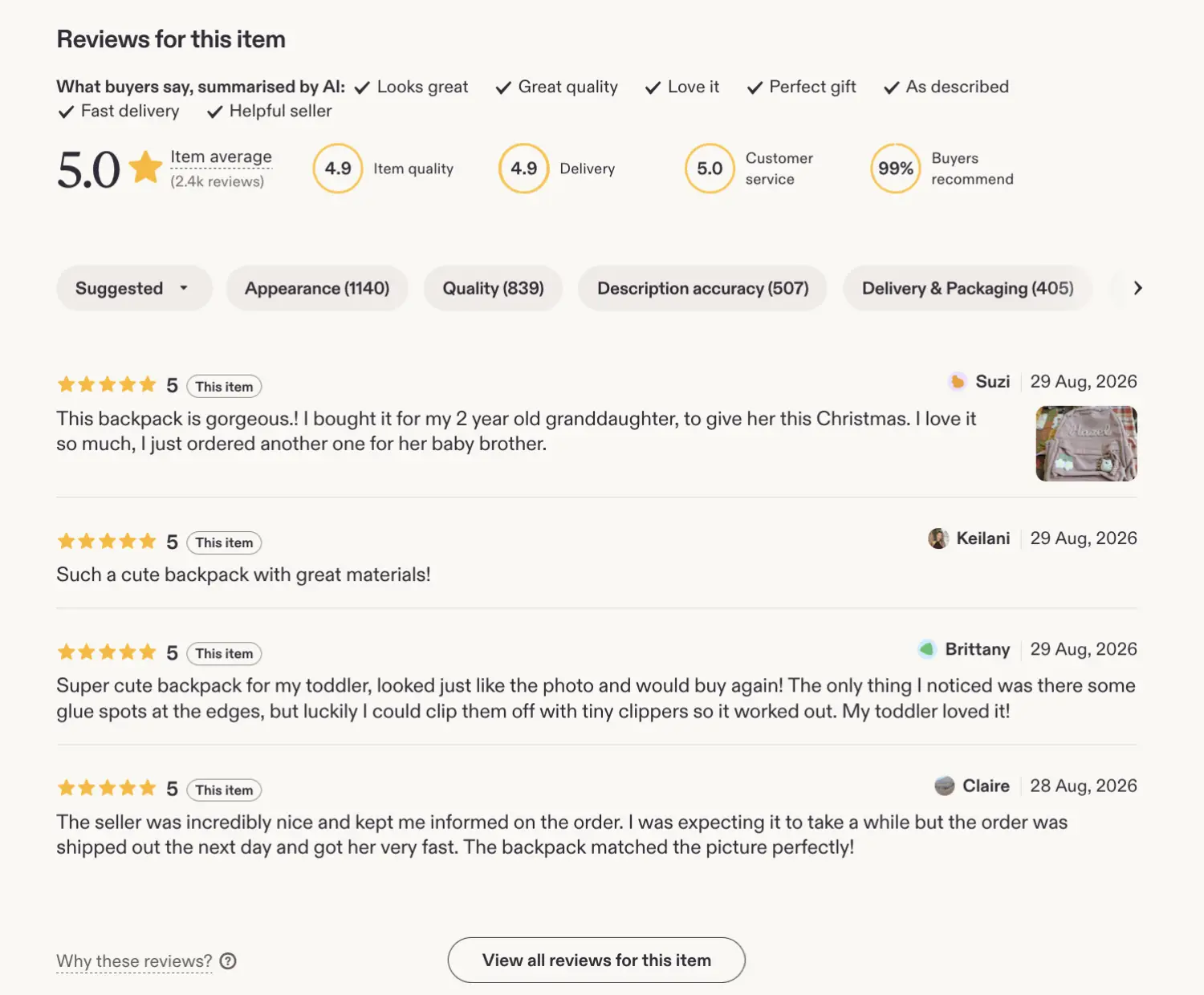
Count recent reviews. Open the top 3 to 5 listings and look at their reviews, especially how recent they are. Reviews only come from actual orders, and the review rate usually is at 10%, so a listing gathering multiple reviews per week is selling steadily right now. This is the closest thing Etsy gives you to a public sales counter.
Score what you see. For each candidate, give demand a simple rating: strong, moderate, or weak. You're not after precision. You're after enough signal to stop guessing.
If you'd like the numbers done for you, research tools like Alura or EHunt can help speed up the process by estimating search volume and sales directly, and the deep dive below covers more about how to use them. But don't let a tool become a prerequisite. Sellers found winning niches with the method above long before the tools existed.
Go deeper: Advanced Niche Research (the research tools, and how to read their scores) · The Trend Fast Lane (if what you've found is a wave rather than a niche)
Toolbox: Niche Research Workbook · Trend Evaluation Scorecard
A faster, riskier route: trend-driven products (see deep dive mini-module: The Trend Fast Lane)
Some products don't need their demand gauged, because you can watch the demand forming in real time: an item or style suddenly everywhere on TikTok, Instagram, and Pinterest, with far more people wanting it than shops supplying it. Riding that wave is a legitimate way to choose a product, and when it works, the huge gap between demand and supply does your marketing for you. But this route has strong prerequisites: You need to be able to have strong design and making skills that go from idea to sellable prototype in days, materials on hand or a supplier you can call today, and being familiar with photography, marketing, etc. If that describes you, read The Trend Fast Lane mini-module before continuing; it replaces most of this step and changes how you use the next one. If not, no loss. The steady route below works in any season, trend or no trend.
Here's a reframe that will serve you for years: Competition is not your enemy.
Competition is proof of demand. An empty niche usually isn't a hidden gem; It's usually a market with no demand. What you're looking for is a niche with healthy demand where you can serve a specific customer better than the big general shops do.
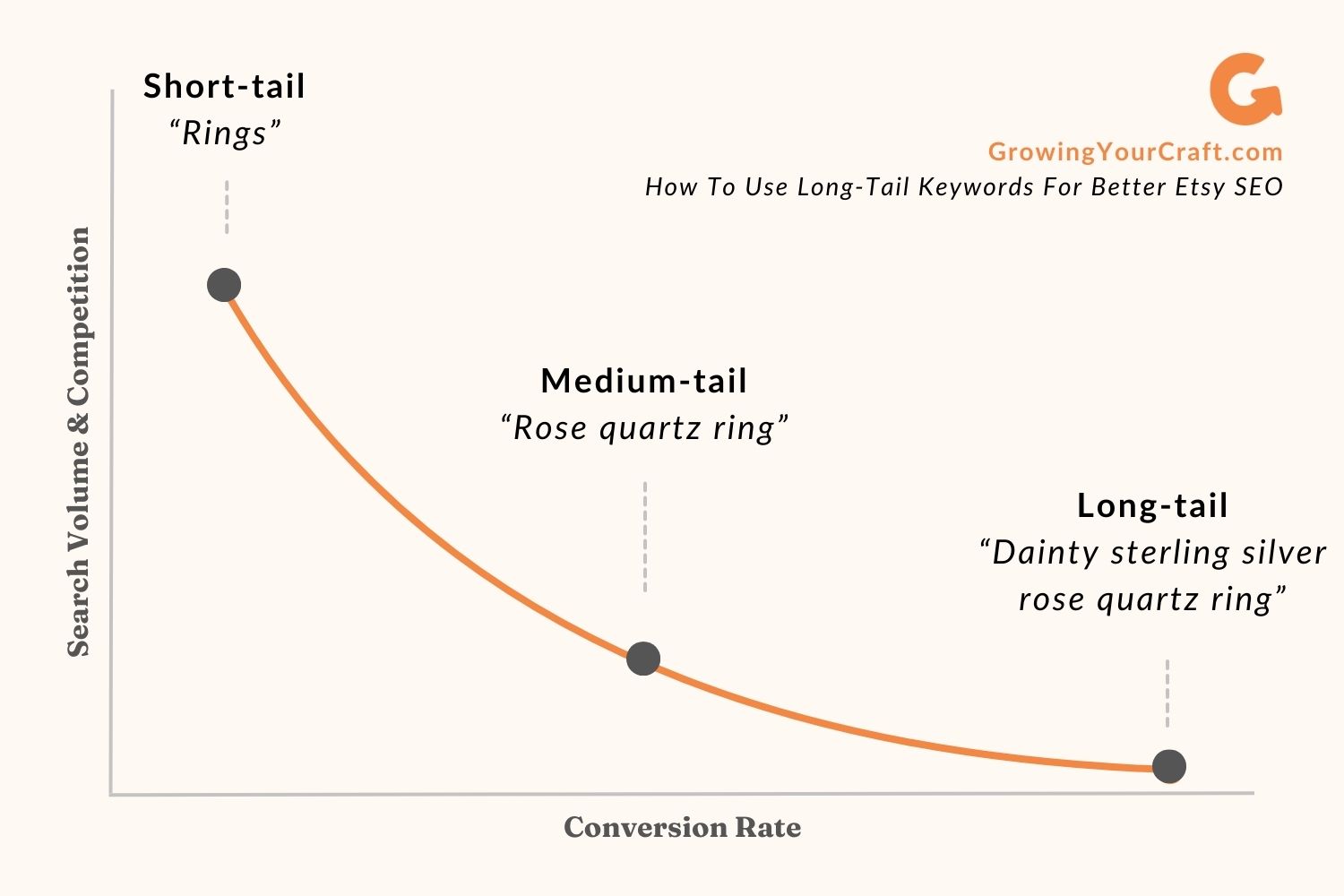
The move is called niching down, and it works like this. "Jewelry" is a big ocean. "Necklaces" is a sea. "Raw amethyst pendant necklaces" is a bay, and "raw amethyst necklaces that can be meaningful birthday gifts" is a harbour where a small shop can be somebody. Each level down, you trade audience size for audience fit, and on Etsy, fit wins. The shop that speaks directly to one shopper's exact search will beat the shop that tries to speak to everyone.
For each surviving candidate from the last step:
Gauge the crowd. Search the niche phrase and look at the results. Etsy will show you pages of search result, but use your honest eye to judge whether the listings actually fit what you've typed in.
Judge the quality, not just the quantity. Open the first page and look honestly: are these photos excellent, or merely okay? Are the listings polished, or coasting? A crowded first page of mediocre listings is an invitation. A crowded first page of superb ones means you'll need better photography and marketing skills to break in, or find another adjacent niche.
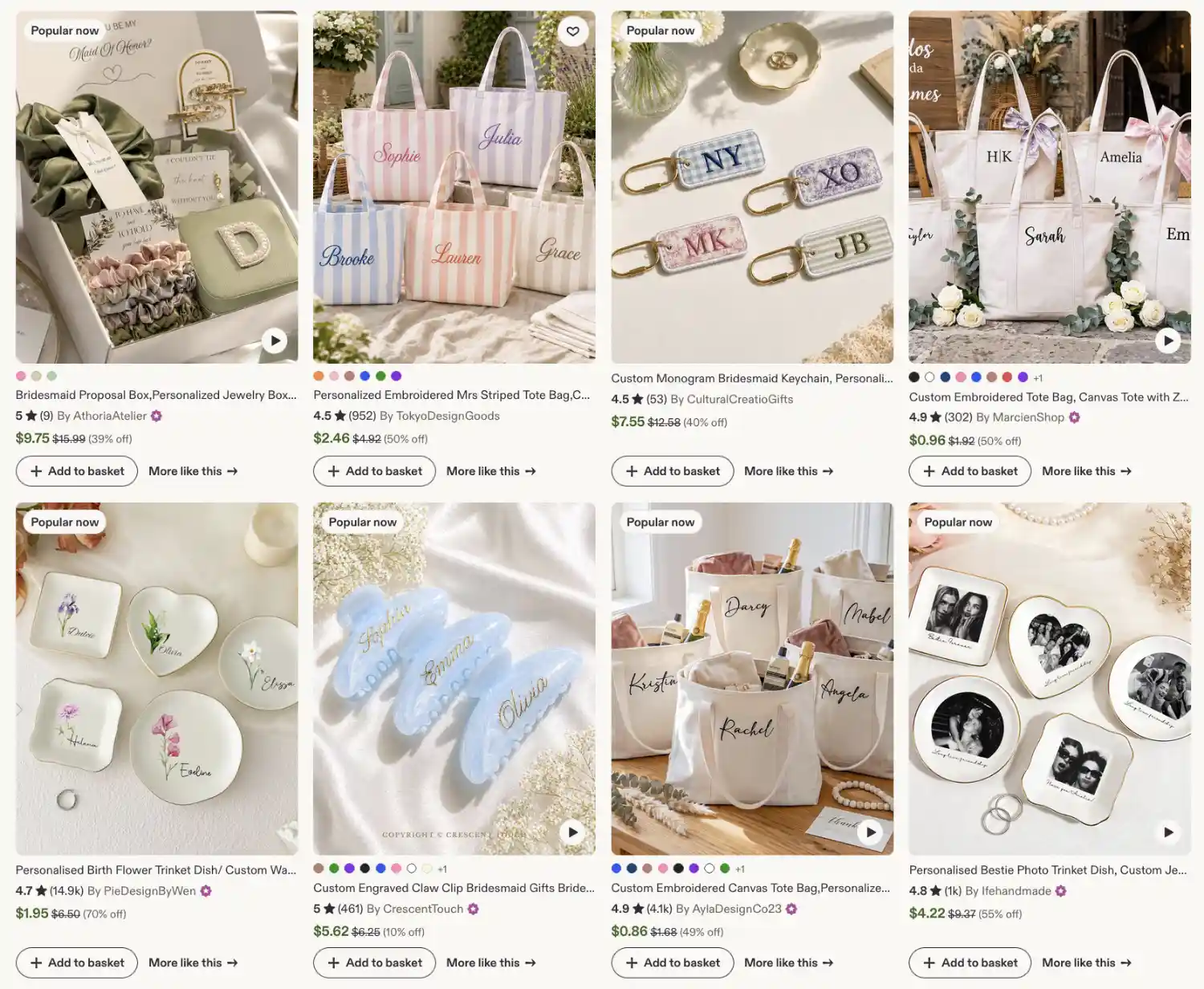
Name your gap. Finish this sentence for each candidate: "Most shops in this niche serve everyone, but nobody is properly serving ____________." If you can't fill the blank, keep niching down or move to the next candidate.
Selling to everyone is selling to no one. It sounds like a poster slogan but it's really true. For example a generic shop may write "high quality wooden decoration", while a shop that knows its target customer writes "fits a standard nursery shelf, safe for little hands". The latter explicitly lets its customers know that "I know what you need".
So before you design a single product, get to know the person you're making it for. Build a short customer persona by answering these:
Who are they? Age range, life situation, and, importantly, are they buying for themselves or as a gift? On Etsy, the gift buyer is often your real customer, and they have different worries (arrival times, presentation, getting it right) than someone buying for themselves.
What's the occasion or moment? A wedding, a new baby, a house move, a self-care Sunday. Products attached to moments get searched for with intent.
What's the pain or the wish underneath? Nobody needs another mug. They want the friend to feel appreciated, the shelf to finally look finished, the morning coffee ritual to feel special. Your product is the vehicle to the feeling they are looking for, a.k.a. the reason for their purchase.
Where do you find all this out? The best source is hiding in your competitors' reviews. Read 20-30 of them in your niche and shoppers will tell you, in their own words, why they bought, who it was for, and what stood out for them. Note the exact phrases they use, as you'll be borrowing this language for your listings in Stage 2.
Write it up as a short paragraph, as if describing a friend: "Sarah is in her early thirties, buys gifts early, worries about things arriving on time, and loves anything that feels personal without being cheesy." That paragraph will quietly guide the decisions you make from here.
Now we go from browsing to studying. Choose the 5 strongest shops in your chosen niche (good sales, solid reviews, polished presence) and put them under the microscope. You're doing two things at once here: Learning the standard you'll need to meet, and hunting for the gaps you'll exploit.
For each of the five, record:
The baseline. Price, materials, sizes and variations offered, shipping speed and cost, and what their photos emphasise. Across five shops, a pattern will emerge: the set of features a shopper in this niche expect. This is your baseline feature list, and your product needs to meet it. Not because you're copying, but because missing the baseline reads as a red flag to shoppers, and matching it earns you the right to be compared at all.
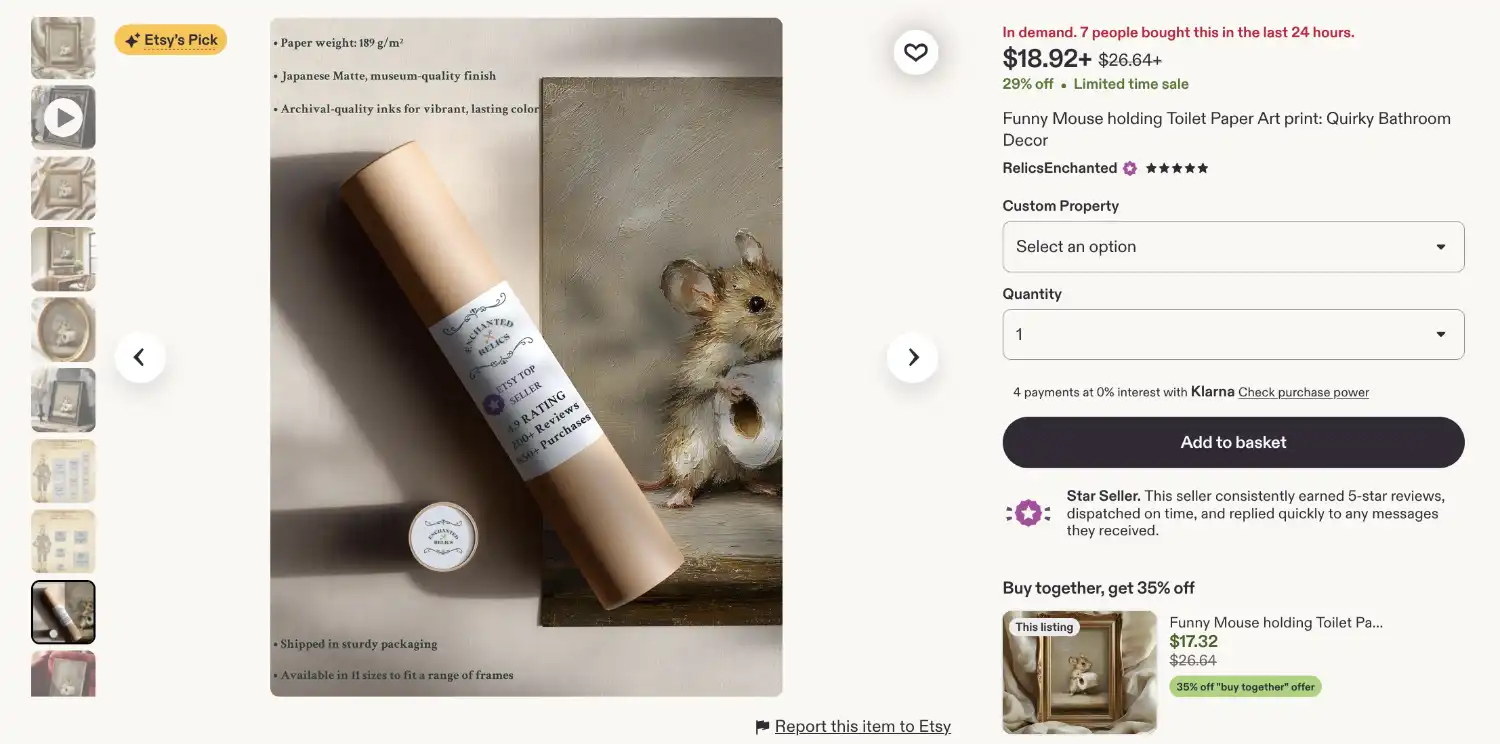
The applause. Skim their 5-star reviews. What gets praised again and again? That's what this customer values most, and it should be front and centre in your product too.
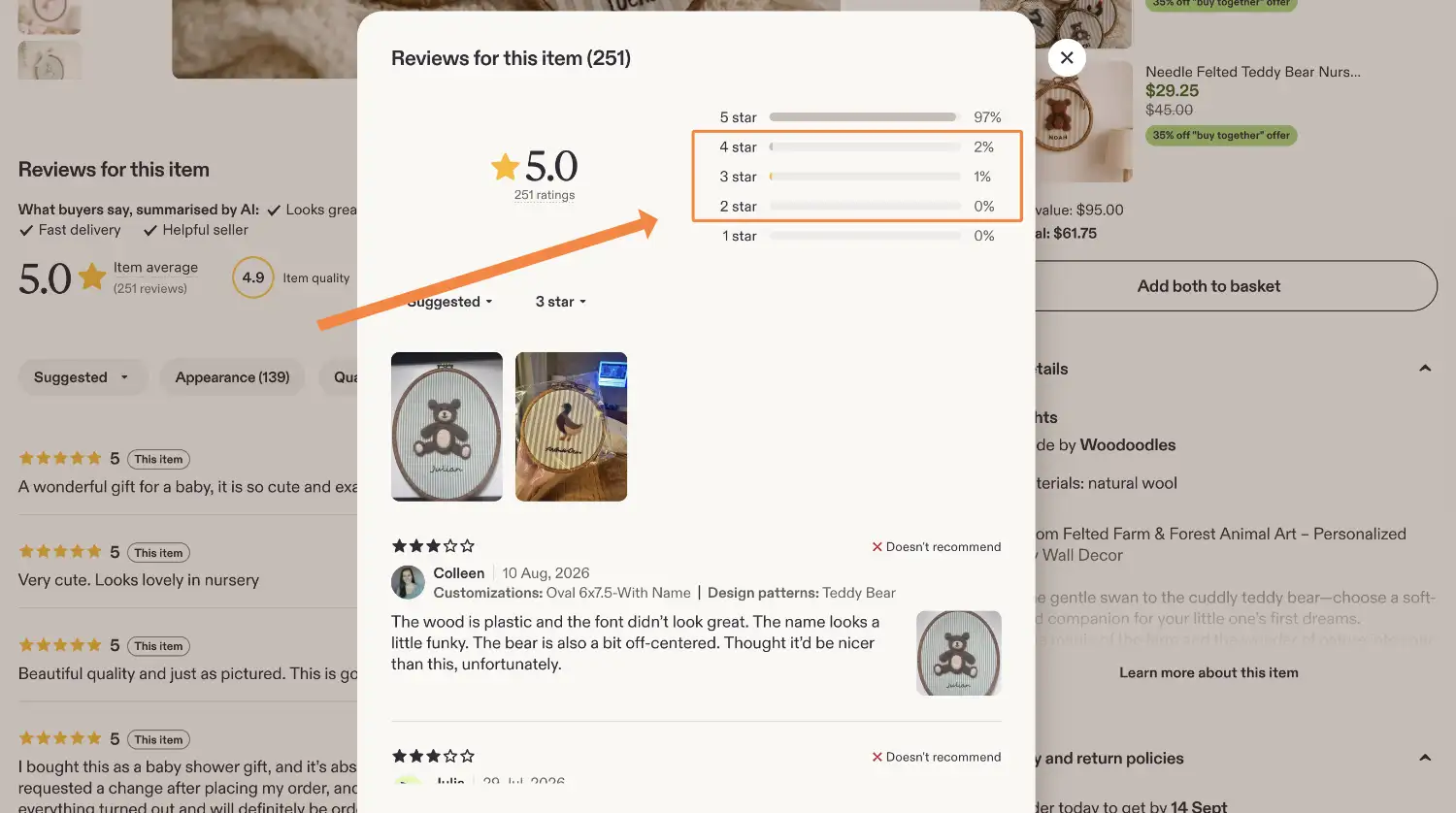
The gold: 2 to 4 star reviews. This is the best free product research on the internet. Middling reviews are where satisfied-but-honest customers tell you exactly what's missing: "beautiful but smaller than expected", "wish it came in a gift box". Every recurring complaint your competitor gets is an opportunity to create something better to fill the gap, so collect them all.
Time to turn all that research into a product decision. Your offer has two layers, and both matter:
Layer one: meet the baseline. Your product includes the features every serious competitor offers (from Step 5), at a comparable quality. This makes you a viable option in the shopper's eyes.
Layer two: Give them a reason to pick you. This is your unique selling proposition (USP), and it's the answer to the only question that matters: "Why should I buy this from you instead of the shop above you in the search results?" And if the answer if not obvious, the chance is they won't pick you over your competitors who likely have more reviews.
Here are the most reliable ways handmade sellers build that answer. A lot of the time, you only need one done well:
- Fix the niche's recurring complaint. Take the 2 to 4 star review gold from Step 5 and build the solution into your product. "Arrives gift-wrapped, always" is a USP if everyone else ships in a plain mailer.
- Offer real customisation. Names, dates, colour choices, sizing. Personalisation is one of the strongest purchase drivers on Etsy, especially for gift buyers. Are there customisation options that's beyond what your competitors are offering?
- Use a distinctive material or technique. Locally sourced clay, naturally dyed yarn, a visible hand-finish. Something a shopper can see in the photos and can't find in a mass-produced version.
- Own a design style. A recognisable aesthetic that makes your work identifiable at thumbnail size. This could be slower to build, but once it's established, the association in your customers' minds could be very strong.
- Bundle for the moment. Combine what your customer is already buying separately: the candle plus the matches plus the card, ready for the occasion you identified in Step 4. Put yourself in their shoes and think what else would they need to make the experience complete.
Notice what's true of every option on that list: none of them can be faked by an AI image or a dropshipper. Your USP and your humanity should point the same direction; that's not an accident, and in Stage 2 we'll make sure shoppers can see both at a glance.
Now write your USP as a single sentence: "Unlike other [niche] shops, mine [the difference], which means [what the customer gets]." For example: "Unlike other dog bandana shops, mine are sized and tested for giant breeds, which means Great Dane owners finally get a bandana that actually fits."
The final test. Put your sentence next to your five competitors and ask: would Sarah (or whoever lives in your persona) pick me, and could she say why in her own words? If yes, you have an offer. If you hesitate, the weak spot is usually the difference being invisible or unimportant. I'd recommend you to go back one layer and sharpen it.
Go deeper: The 13 Ways Of Developing A Unique Handmade Offer (the full menu, with examples for every route)
You likely have two or three candidates that survived everything above. Time to pick one, and only one. A focused shop with a small, coherent range in a single niche will outperform a scattered shop every time, because Etsy's algorithm and human shoppers both reward a shop that clearly knows what it is.
Score each finalist from 1 to 5 on four things: strength of demand evidence (Step 2), clarity of your gap (Step 3), strength of your USP (Step 6), and, honestly, how much you'd enjoy making this every week for the next year. That last one is important. Making something that you're passionate about means much lower chance of getting burned out.
Highest total wins. Write it down somewhere you'll see it: the niche, the persona, the USP sentence. That's your founding document, and it will guide you in your future decisions.
And if the runner-up idea still tugs at you, good news: it's not dead, it's queued. Stage 6 covers opening a second shop for a distinct niche once your first one is humming. But one at a time.
And while you're there, train your feed. Spend ten minutes searching your niche and liking, saving, and following the strongest product posts you find. You're teaching the algorithm what you care about, on purpose. Within a day or two (or even an hour or two), the platform will start delivering the most engaging posts in your corner of the market straight to you: The styles gaining momentum, the colours people are responding to, the reel formats getting saved and shared. Turn your analytical brain on when you scroll your shop account's feed. Save anything that jumps out to you in a saved folder called "inspo".
Next comes Stage 2: Launch a Shop That Converts, where the research becomes something you can see. Branding, pricing, photos, keywords, and listings built to turn visitors into buyers. It's the most hands-on stage of the roadmap, and there's a pleasant surprise waiting inside it: some of the decisions are already made. Your customer told you what to photograph. Your competitors told you what to fix. Your USP told you what to say. All that's left is the making, and the making is the part you're good at.