
In Stage 1, Step 6 you learned the principle. Meet the baseline first, then pick one way to stand out and do it well. This module gives you the full menu behind that choice. You get thirteen proven ways to develop a unique handmade offer, each one with examples. After that comes a system for refining the products already in your shop. Then we cover two sharp tools, gimmicks and limited editions, and how to use them honestly.
The 13 ways of developing a unique handmade offer
One route done well beats five done half-heartedly. Read through the menu. Notice which two or three fit your craft and your customer. Then commit to one.
1. Scale disruption
Play with size. Make your product much larger or much smaller than people expect. The visual surprise grabs attention on Etsy, and novelty pieces like these tend to spread on social media on their own. When you photograph the piece, always show it next to a common object or next to its normal-sized version. That way the scale lands straight away.
For example, you can go big with a oversized fish soy sauce lamp:

Or go small with miniature food earrings:

2. Niche specialisation
Serve one specific corner of the market so precisely that you become the obvious shop for it. This is the core method of the whole roadmap, and Stage 1 taught it end to end. Here it is again, as a product strategy.
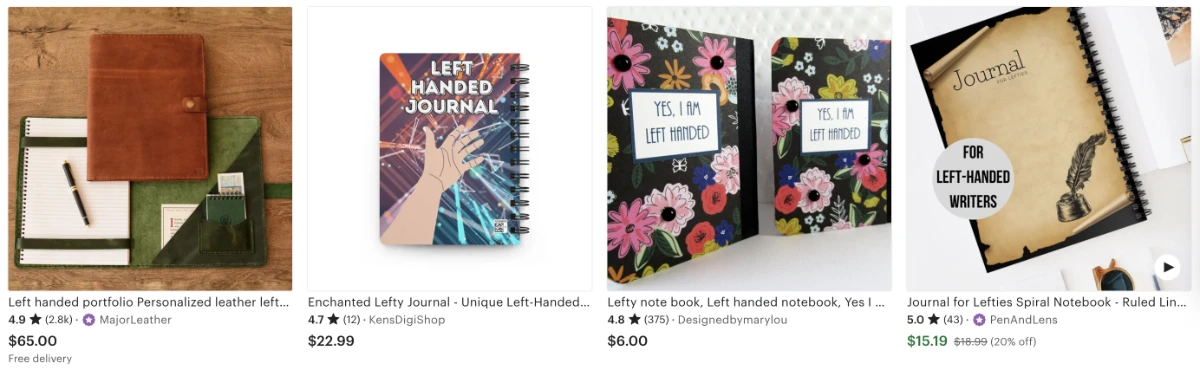
Research is what makes this work when most sellers fail at it. Read your target customers' complaints in forums and groups. Mine the 2 to 4 star reviews of your competitors. Then build the product that answers what you found, and say so plainly in your photos and your description. Examples: Eco-friendly stationery for environmentally conscious professionals, vegan meal planners with shopping guides, or a left-handed notebooks with the spine on the right like these:
3. Unexpected materials
An unusual material makes a familiar product feel new. Study your niche and look for materials nobody is using. You might borrow one from another industry, or invent one yourself. Check that you can source it at a price that works. Prototype it, then test it for durability and comfort. After that, put the material everywhere: your title, your close-up photos, your video, and your description.
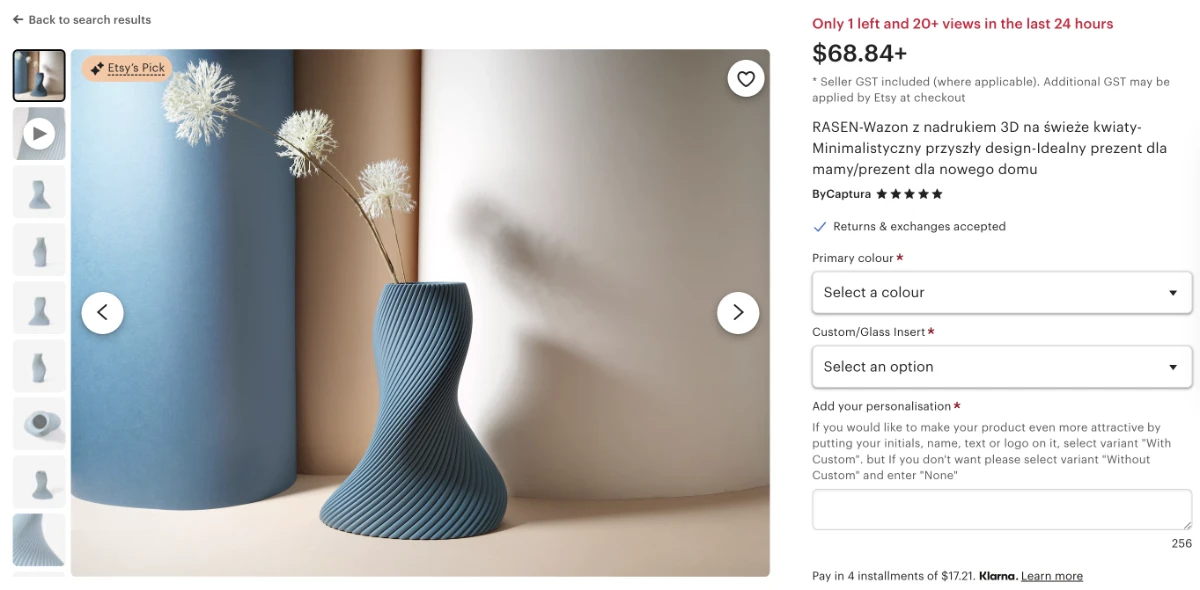
You have one more job. Teach shoppers why the material is better for them. If there is no practical benefit, tell the story of how you found it instead. A special material with a story behind it gives you two selling points instead of one. Instead of a ceramic or wooden one, some sellers found success in the 3d-printed vases space with interesting designs:
4. Personalisation plus
Personalisation is common on Etsy. This route means offering the personalisation your competitors don't. There are four ways to do it.
The first is unusual options, like a t-shirt in leather or linen, or a recipe book with a custom cover. The second is deeper customisation. If your competitors let buyers choose a colour, you let them choose a colour and a size. The third is simply more options, such as more patterns and more materials. The fourth is a customer message option, which is the gift maker's favourite. It makes any product more giftable, and it stands out most in a niche where nobody else offers it.
When you involve the customer in the design, you raise the value they see in the product and the price you can charge for it.
5. Cultural connection
Products that connect with cultural themes, traditions, and identities tap into pride, nostalgia, and curiosity. They create an emotional bond that a generic product can't. Research the symbols, patterns, and colours properly, and think about products for cultural festivals and events.
The non-negotiable element here is authenticity. Only work with cultural themes you genuinely know, so that your work is appreciation rather than appropriation. If the heritage is your own, tell that story. Nothing else connects with people the same way. For example, if you grow up in Hong Kong, making Hong Kong neon sign stickers could be a great idea:

6. Sensory experience
Engage the senses beyond sight. Think about touch, smell, sound, and even taste. A product that works on more than one sense is more memorable, it stands out in the customer's mind, and it earns word of mouth. Highlight the experience in your listing photos, ideally with a model acting it out. Lean on your listing video too, because movement is how a screen conveys the senses. This route is hard to apply to digital products, so if you sell digital, routes 12 and 13 are yours. Think about all our senses, maybe you'll come up with products like scented soy candles, textured baby toys, exfoliating bar soap, garden decor with built-in wind chimes. Or you may come up with suncatcher-inspired decors that plays with light like these:

7. Modular systems
Build products from interchangeable parts that customers can combine, customise, and expand. There are three advantages here. The buyer gets flexibility. The product gets an interactive element that makes it fun. Best of all for you, it comes with a built-in product line, so you can sell starter kits with the essentials and expansion packs for your existing customers. That is exactly the kind of repeat purchase Stage 4 is built around.
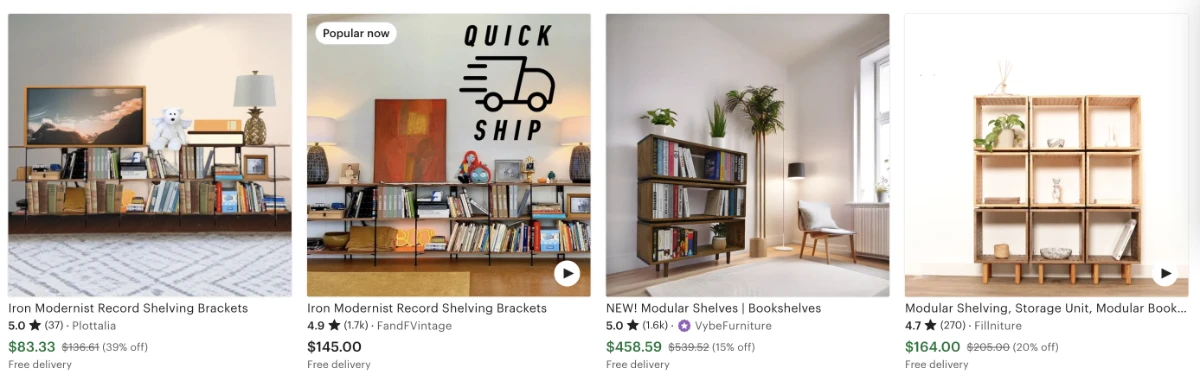
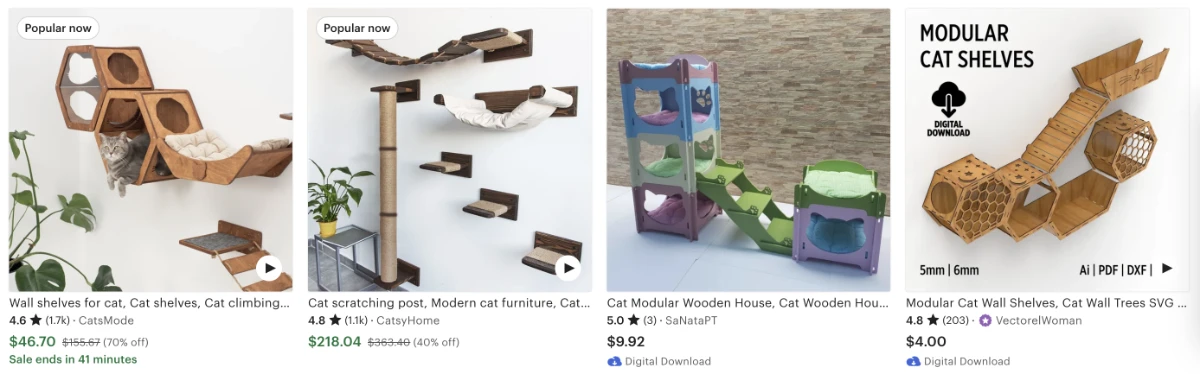
The skill in this route is compatibility. For physical work, that means standardised sizes, connectors, and attachment points. For digital work, it means compatible formats and templates that combine. For example, modular jewelry where pendants swap between necklace and earring hooks, modular digital planners with add-on habit trackers and budget sheets, stackable TV cabinets, and modular cat furniture.
8. Functional art
Make something beautiful that also has a job to do, or something useful that is pretty enough to display. The overlap between decorative and practical is permanently underserved. You can go further by adding an element that transforms or invites interaction, like a picture frame with movable magnetic pieces. Examples: decor with hidden storage, a luggage tag with an AirTag compartment, a candle that becomes a planter after its last burn, and wall art with lighting:

9. Innovative use
Find the unconventional use for your product and promote it. You are looking for the second benefit that isn't obvious.
Sometimes this needs a small physical addition, like an attachment that turns a desk light into a selfie light. Sometimes it needs no change to the product at all. A naturally low-sugar snack can be marketed as the weight-loss option. A hydration cream that also calms redness opens up the whole sensitive-skin audience.
Ask this of every product you sell. What else does it quietly do, and who would buy it for that reason alone? Examples: the selfie light attachment, a metal board marketed as a fast defrosting board, and an essential oil that doubles as bug repellent.
10. Cross-niche innovation
Borrow a style, technique, or feature that works well in another niche and bring it to yours. It doesn't have to be new to the world. It only has to be new to your corner, and that freshness is what makes you stand out. Examples: kintsugi brought to DIY kits, which is the Japanese technique of repairing ceramics with gold. Leather used for flower bouquets with leather petals. Ocean resin, which is a chopping board technique, applied to jewelry, like this:

11. Retro revival
Nostalgia sells, and vintage looks brought into modern products tap into it directly. Pinpoint the iconic elements of a decade and weave them into contemporary pieces. Think of 1960s bold geometry, 1970s earthy bohemian, or 1980s neon and metallics.
One caution. Retro has been popular long enough that some corners of it are saturated, including retro wall art and retro dresses. Check whether your competitors already use this style before you bet on it as your point of difference. Examples: 1980s-inspired Instagram templates, VHS tape keychains, modern takes on retro board games, retro console art, and a bohemian mirror with a rattan frame.

12. Digital interactivity (digital products)
Go beyond static files and give the customer something to actively engage with. There are two flavours. The first is on-screen interactivity, such as fillable PDFs, clickable navigation, and dynamic content. The second is physical interactivity that comes out of a printable, where the customer cuts, assembles, or decorates. Offer both layers in one product and you have a value stack most of your digital competitors won't attempt. One good example is printable children's craft kit designed for cutting, folding, and assembling like these:

13. Dynamic digital designs (digital products)
Movement and multimedia make digital products stand out. Animated and video-based designs feel more alive and more premium. You get a bonus on the search page too. Your listing video autoplays when someone hovers over it, so it demonstrates the movement that is the product. For example, animated birthday e-invites, Instagram reel video templates, looping animated phone screensavers, and video product mockup templates.
Refining what you already sell
Even a product that sells well today sits in a market that keeps moving. Customer preferences drift. Competitors catch up. Copycats arrive, and they always arrive. The skill that matters over the long run is not the perfect launch. It is adaptation. This section gives you a system for it, and it pairs directly with the renewal habit in Stage 6, Step 2.
Refine or develop?
Develop something new in three situations. The first is when the product isn't getting sales at all. The second is when the market has genuinely moved, because demand collapsed or competition saturated, and the product can't follow. The third is when innovation has made the product redundant, because nobody needs a case for a phone that nobody owns.
Refine what you have in three other situations. The first is when the product sells acceptably but could sell better. The second is when several customers point at the same improvement. The third is when a market trend gives you a chance to add value to something that already works.
Should you use the same listing or a new one? Let the size of the change decide. A smoother buying process, an added FAQ photo, or clearer sizing all belong on the same listing, because its history and its reviews keep working for you. A genuinely different product needs a new listing, so that expectations and reviews stay accurate. Your tote bag reborn in heavy waxed canvas is a new listing.
The eight reasons customers don't buy, and the fix for each
Gather your reviews, your messages, and any feedback you have. Then look for these patterns. Fixing even one of them will measurably lift your conversion rate.
- They doubt the quality or how long it will last. Showcase your making professionally, and add close-up photos of the craftsmanship. Offer a guarantee if it is one you can stand behind.
- Something they want is missing. When several customers ask for the same thing, that is not a complaint. It is a specification. Think of the coin pocket in the wallet, or the QR code on the business card design. Build it into your next batch.
- The buying process is complicated. If shoppers keep messaging you to ask how it works, your listing is confusing. Add a how-it-works photo. Put a step-by-step in the description. Add an FAQ that answers the questions you keep getting.
- They are unsure about fit or size. Give them a size guide, customisable sizing, and forgiving exchange terms. Show photos on different models. A free ring-size guide before the purchase prevents a return after it.
- They have concerns about the packaging. Packaging that is wasteful, non-recyclable, or not gift-ready quietly costs you sales in some niches. Fix what you can fix. Then photograph the answer, like a recyclable box with a caption that says so.
- The materials are wrong for them. Allergies, sustainability, and personal preference all make materials a dealbreaker for some buyers. Offer hypoallergenic alternatives where that makes sense. Move towards eco-friendly materials if your niche rewards it.
- Your look has drifted out of style. When your aesthetic stops resonating, research what the market likes now and adapt within your brand. If boho is rising and it suits you, bring boho elements into your decor line. Your feed radar and your quarterly drift-listening will give you the signal.
- Your price has no visible reason behind it. If you cost more than your competitors, the buyer has to be able to see the difference. Show the materials, the craft, and the packaging properly in your photos and description. The full method for defending and raising your prices is in the Charging More With Confidence deep dive.
Refinement never finishes, and that is good news for you. A shop that listens and improves is almost impossible to copy, because a copycat can only ever copy the version of your shop that already exists.
Gimmicks done right
The word "gimmick" sounds like an insult, but it doesn't have to be. A gimmick is simply a deliberate difference that draws attention. It might be an unusual material, like jewelry made from recycled plastic or leather made from cactus. It might be an innovative design, like a cup handle that doubles as a spoon rest. It might be an interactive feature, like a candle that reveals hidden jewelry as it burns.
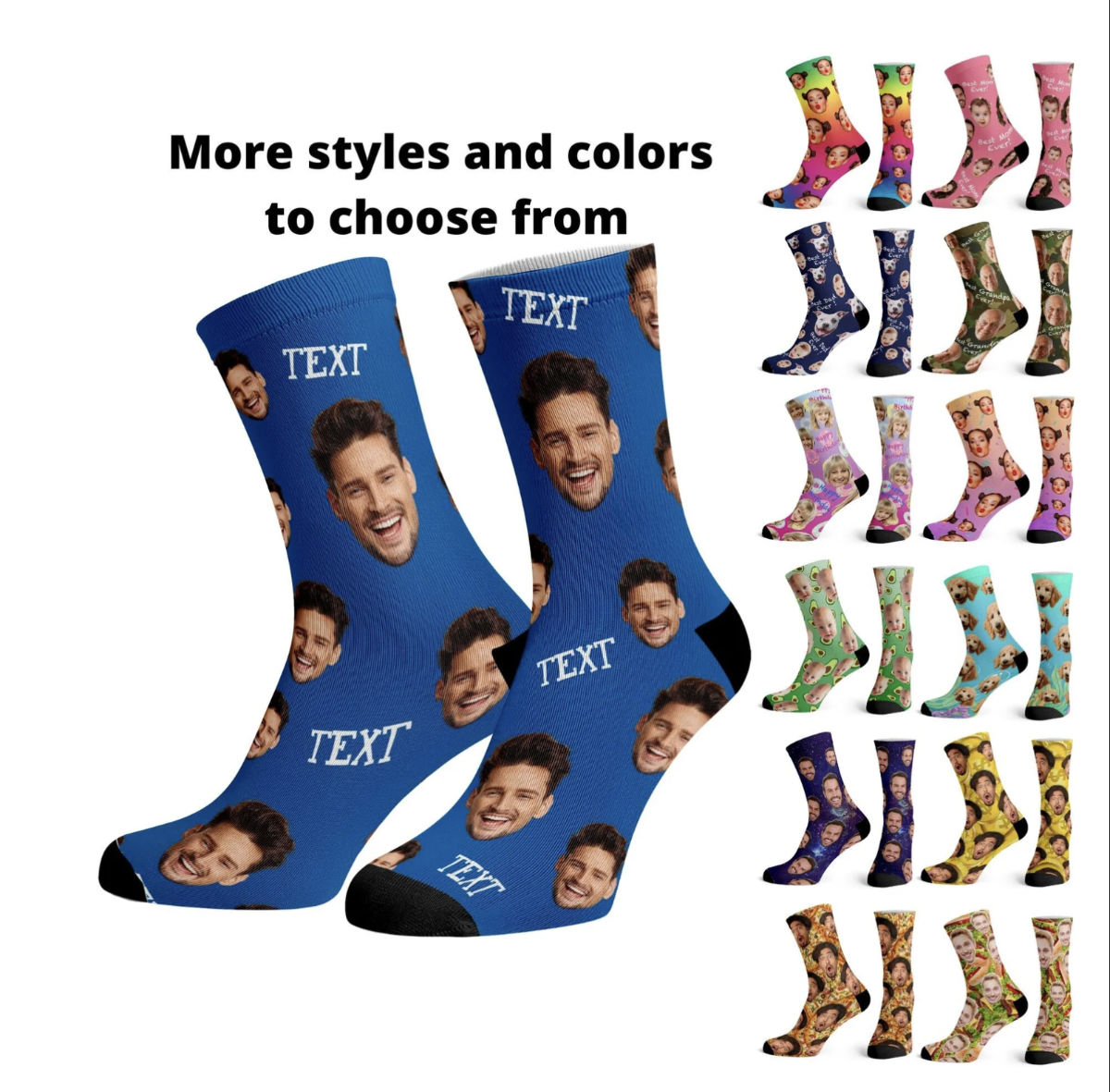
One rule separates a winning gimmick from a losing one. Your gimmick must never cost the product its quality. Socks printed with a custom face are a delightful gimmick, and they only work because the socks themselves stay comfortable and hard-wearing. The novelty earns you the click. The quality earns you the five-star review. You need both.
Seasonal and limited editions
Limited products use genuine scarcity, which is one of the most persuasive forces in selling. The honest kind of scarcity is easy to create. Release a new design for the season, like snowflake embroidery on your winter bag. Use a material that is only available part of the year. Choose colours that belong to a festival or a season. Or put together a special bundle that combines products into a limited set.
Then tell people about the scarcity plainly, and let the roadmap's honesty rules govern how you do it. Only state real numbers and real endings. "Only 3 of this design left, and it won't return this year" is powerful because it is true. Give the edition a reason, exactly as Stage 5, Step 4 asks of every sale you run. Then honour the ending you announced. Scarcity you invented will cost you your customers' trust eventually. Genuine small batches are one of the most natural advantages a handmade shop has.
A note on trends
Trend-driven products deserve their own system, and they have one. The Trend Fast Lane mini-module covers how to tell whether a wave is rising or breaking, the legal tripwires to watch for, the workflow for moving fast, and your exit plan.