
In Stage 4 you built the machine. That covered your platform, your lead magnet, the three doors, your welcome sequence, your campaign rhythm, and the repeat mechanics. This module takes you deeper into all of it. You will learn how to choose a lead magnet precisely, all five ways to grow your list, how to write emails that get opened and clicked, how to plan your sending calendar, and how to read your numbers without obsessing over them. The sequences you can copy and edit live in the Email Automation Templates pack in your Toolbox.
Choose your Lead magnet
In Stage 4, Step 2 you learned the four magnet types. Now add one more layer of precision. You need to know who you are trying to attract, because there are two very different people on the other end.
Shoppers haven't bought from you yet. They respond to anything that lowers the barrier to a first purchase. Think of a 10% welcome code, first-look access, or a useful printable for your niche. Your link in bio and your website forms mostly catch shoppers, so lead with these magnets there.
Customers have already bought from you. They respond to magnets that extend the purchase they made. Think of a care guide that protects what they own, early access to your next batch, or a companion printable. Your insert card and your receipt message reach customers, so those doors can lead with care and belonging instead of discounts. That protects your margin too. Someone who just paid full price doesn't need a coupon to join your list. They need a reason.
Matching the magnet to the door takes about ten minutes, and it lifts both of your sign-up rates. It is also the refinement handmade sellers miss most often.
The five ways to grow your list without breaking a rule
The permission rule from Stage 4 applies to all of this. Never add anyone to your list yourself. Build doors instead, and let people walk through them. Here are the five doors, ordered by how much effort each one takes.
- The insert card. Put one in every parcel, with a QR code to your magnet. It reaches customers at the moment they are most delighted, and it keeps working forever for the price of printing.
- The order receipt message. This goes out automatically, so you only need one warm line of invitation. Write it once and it costs you nothing after that.
- Your link in bio. This is where everyone who wanders over from social media lands. State your magnet plainly there.
- Your website forms and checkout capture. These arrive from Stage 6 onward, and they are the strongest intake of all, because the purchase and the permission arrive together.
- Content that earns the ask. Every so often, write a social post or a blog piece whose whole point is the magnet. Something like "I wrote a care guide, and it's free" works well. Once a month is plenty, and it works because the magnet is worth having.
One note on giveaways, because every seller asks. A giveaway grows your numbers fast and your quality slowly. Prize-hunters sign up for the prize rather than for you, and then they sink your open rates. If you do run one, make the prize your own product, so entrants at least want what you make. Then expect to prune your list afterwards.
Writing emails that get opened
The subject line. Four patterns work reliably on a maker's list. The first is curiosity with clarity, like "The kiln did something strange this week". The second is plain news, like "The spring collection is here". The third is useful and specific, like "Three ways to make your candle last longer". The fourth is honest urgency, but only reach for it when the urgency is real, like "Last day: the bundle price ends tonight".
Avoid ALL CAPS, rows of emojis, fake "RE:" subject lines, and urgency you invented. They may get you some opens today, but it's not worth the loss of trust in your subscribers.
The preview text. The grey line after your subject is a free second subject line. Write it on purpose, and use it to extend the thought. Something like "and what it taught me about glazing" does the job. Don't let "View this email in your browser" waste the slot.
A few things matter beyond those two lines. Send from a consistent, human sender name, which is usually your shop name. Keep a steady rhythm so your name stays familiar. And remember that the best open-rate strategy is simply a track record. People open emails from senders whose last three emails were worth opening.
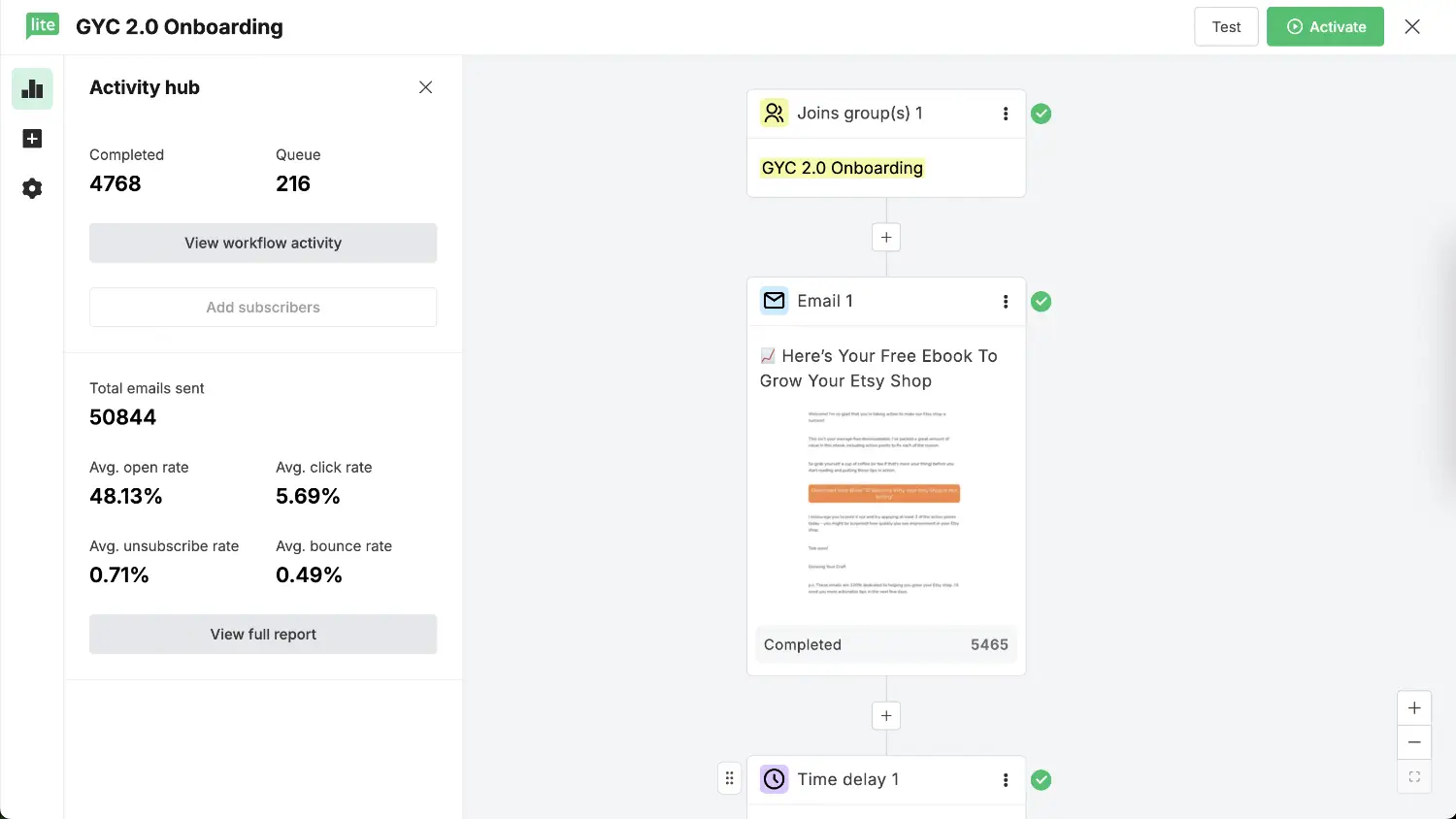
Writing emails that get clicked
Follow these four rules when drafting your emails:
One email, one job. Stick to a single topic and a single call to action. Two asks in one email may decrease your clicks in general because the message is unclear.
Write to one person. Use your brand voice, exactly as your sequences already do. An email that reads like a letter beats one that reads like a broadcast.
Let the photos create the desire. Use one or two strong product or process photos. Don't send a catalogue.
Put the link where people will actually tap it. Add a clear button or link high in the email, then repeat it once at the end. Write link text that says what will happen, like "See the new batch", rather than "click here".
Use your Share & Save on every link that goes to Etsy, every time, so your clicks save 4% on Etsy fees as well.
About deliverability
Deliverability is important as that affects whether your customers actually get your emails. Avoid styling that looks like spam, meaning all caps, piles of dollar signs, and twenty links in one email. Always include the unsubscribe link and physical address your platform inserts, because both are legally required. And complete your platform's domain authentication steps once you are on your own domain. None of this is daily work. It takes an afternoon to set up and a glance each quarter after that.
The sending calendar
Your campaign rhythm from Stage 4, Step 5 is monthly at minimum and weekly at your peak. You fill that rhythm from a rotation. Here is what a year of it looks like.
Announce new pieces and restocks as they genuinely happen. Send one care or tips email each quarter, which gives without asking for anything back. Send one behind-the-scenes letter each quarter, which is your human-made advantage in action. Time your seasonal gift guides to your shipping cutoffs. Run the promotion events from Stage 5 with their three-email arcs. Underneath all of it, your automated flows keep humming along, including your welcome, post-purchase, replenishment, and occasion emails.
If you ever sit down with nothing to send, this rule of thumb will rescue you. Teach something, show something, or announce something. And never apologise for a gap. "Sorry I haven't emailed" is the one opening line with no job to do.
Reading the numbers
Your open rate tells you about your subject lines and the health of your list. On a small handmade list, a healthy open rate usually sits well above the big-brand averages, because your list actually knows you. Watch your own trend rather than an external benchmark.
Your click rate tells you whether the job of the email was clear.
Your revenue per email is the number that rules. Track it exactly as Stage 4 taught, using your email-only code and your platform's revenue reporting. A modest list that buys will beat a large list that only watches, every time.
Prune your list gently, twice a year. Send the win-back email to anyone who hasn't opened in six months or more. The template for it lives in From Buyers To Regulars. Then remove the people who still don't respond. This always feels like shrinking your list, but you are really improving it. A smaller list that opens keeps your deliverability strong for the people who do want to hear from you.