


5-star reviews are amazing to read. For research, though, they're not very useful.
"Beautiful, love it, fast shipping" tells you the seller did a good job. It doesn't tell you what the customer wished was different.
2-to-4-star reviews, however, are another story. A 3-star review is usually written by someone who wanted to love the product and couldn't quite. And they almost always explain why. So in this guide, you'll see how you can use them to make better decisions when improving the products on your Etsy shop.
Let's get started.
Why Middle Reviews Beat Both Ends
Each type of review tells you something different:
- 5-star reviews are happy but vague
- 1-star reviews are often about a lost parcel, a one-off mistake, or a bad day, rather than the product itself
- 2-to-4-star reviews tend to be calm, specific, and about the product
That third group is where the useful information lives. Comments like "the colour was darker than the photos", "lovely, but smaller than I expected", or "great quality, but it came in a plastic bag and I'd bought it as a gift" point straight at something tangible you could do better.
How to Find Them
Pick five direct competitors. These are shops selling something close to what you sell, to a similar kind of customer. Use the bestsellers on the first page of your main search phrase as a starting point. Those products will also have more reviews for you to read.
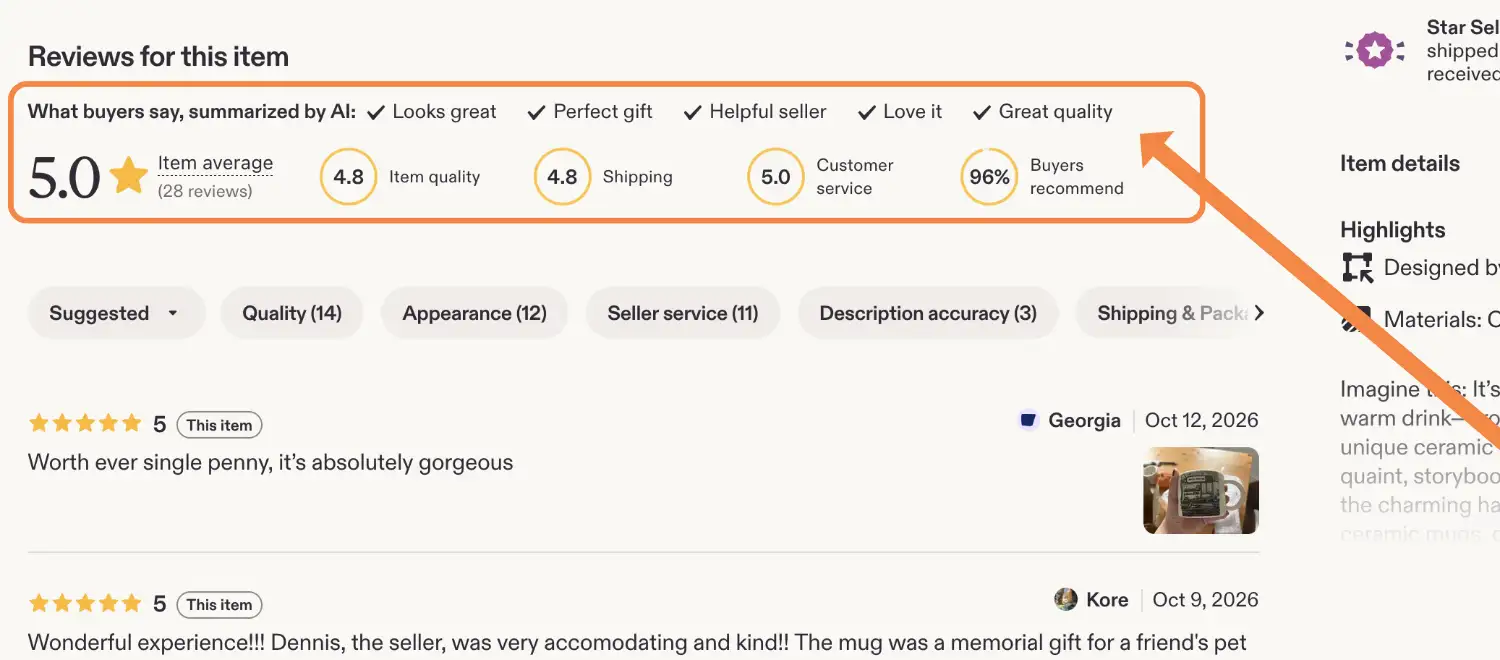
Read their listing reviews first. Open each shop's top-selling listings and read the reviews there, starting with the most recent ones, since those reflect the product as it is today and give you a good idea the general consensus of what people think about that product.
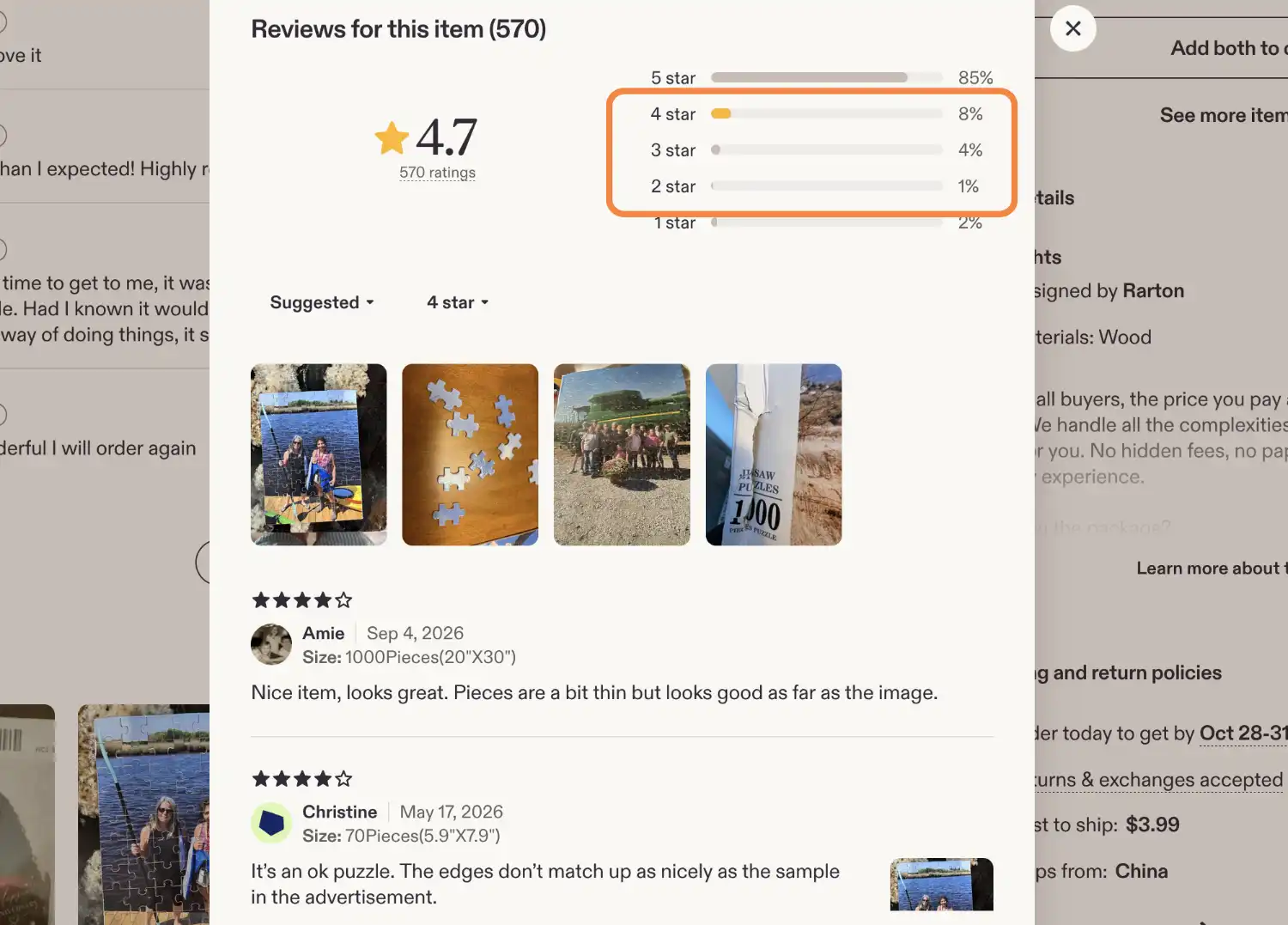
Then read the 2-to-4 star reviews of the item. Click "View all reviews of this item" and then the click 2 star, 3 star and 4 star to filter the reviews.
Look beyond Etsy for extra insights. The same product type often sells on Amazon and other marketplaces, where three-star reviews are plentiful and just as revealing.
Write Down Two Things
For every useful review, record these two areas: The gap & their exact words. For example:
The gap: Smaller than expected. Their exact words: "tiny", "smaller than it looked"
The gap: Scent fades quickly. Their exact words: "barely smell it after a week"
The gap: Not gift-ready. Their exact words: "came in a plastic bag", "had to rewrap it"
The gap tells you what to fix. And their exact words tells you how customers talk, which you can use those exact words when you're rewriting your Etsy listing description.
Sort the Complaints Into Four Groups
Not every complaint needs a product change. Sorting them into these 4 categories tells you where the fix belongs:
- Product problems. Size, colour, material, durability, or strength. These are fixed in the product itself.
- Expectation problems. "Smaller than I expected" often means the listing didn't show scale clearly. These are fixed in your photos and description, and the product may be perfectly fine.
- Experience problems. Packaging, gift-readiness, delivery times, or slow replies. These are fixed in your packaging and policies.
- Value problems. "Nice, but not worth the price." These are usually fixed by showing the value more clearly, rather than by dropping the price.
Turn the Recurring Complaint Into Your Selling Point
When the same complaint shows up in three or more different shops, it isn't bad luck. It's a gap in the whole niche, and those are the gaps that allow new shops (maybe your shop!) to step in and win customers.
For example, if buyers keep saying items arrive in plain plastic, your selling point might become "arrives gift-wrapped and ready to give, every time." If buyers keep saying the size surprised them, then your fix may be showing the product on your hand or some commonly found objects to show the size clearly.
There's one rule here. Your selling point has to be something you'll genuinely do on every single order. A promise you can't keep simply becomes your own three-star review.
Use Their Words in Your Listings
Go back to your second area: Their exact words. Customers search in the same words they complain in.
If reviewers keep saying "chunky", use "chunky" in your title and description rather than "substantial". If they say "gift for mum", that's a phrase worth considering for your tags. Their language makes your listing feel familiar to the next Etsy shopper who reads it.
A Few Ground Rules
- Learn from competitors, don't copy them. You're studying what customers want, not taking another maker's design or photos.
- Don't contact the reviewers. Especially because they are not your customers.
- Look for patterns. One review is an anecdote, but the same point in three different shops is a pattern worth acting on.
- Revisit regularly. Complaints change as a time goes by, so re-read a few reviews every few months.
Where This Fits in Your Etsy Success
Studying competitors and building a genuine point of difference are Steps 5 and 6 of Stage 1 in the GYC Etsy Success Roadmap: Find Your Winning Product.
Inside the GYC Etsy Academy, the Niche Research Workbook has a competitor table with space for exactly these gaps and phrases. And the deep dive called The 13 Ways Of Developing A Unique Handmade Offer walks through thirteen different routes for turning a gap into a product people choose over everything else on the page.
If this approach already sounds useful, the rest of the Roadmap is built the same way. Click here to explore the Roadmap →


